Traceable Nettle Fibre: How Nettle Circle Verifies Its Himalayan Origin
Nettle Circle is building a supply chain for a new natural fibre: wild nettle from the Himalayas. With no globally recognised certification standard for nettle yet, brands had no way to verify its origin. An early partnership with Haelixa changed that. Each batch is marked at source with an invisible DNA marker, making the fiber traceable from bark to finished product.

Nettle Fibre as a Next-Gen Material
Nettle fibre is still a niche product, but it can be grown with far fewer inputs than cotton. While cotton plants often require pesticides and chemical fertilisers, nettles naturally resist many pests and do not need chemical treatment.
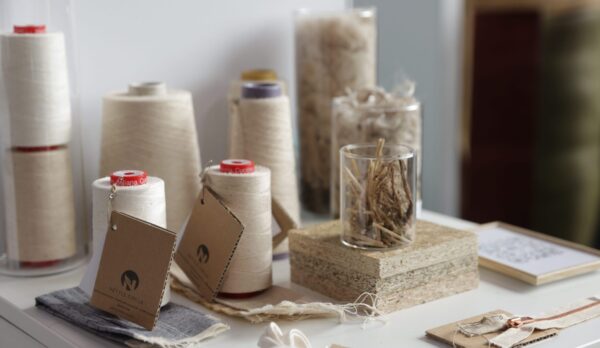
Local villagers in the mountainous regions of Nepal collect wild nettle for the Nettle Circle Fibre HILAYA®. The work provides them with an additional source of income, especially in winter and spring, before the busy farming season.
What is Himalayan nettle fibre?
Himalayan nettle fibre is a natural bast fibre taken from the bark of wild nettle plants that grow in the mountains of Nepal. It is strong and versatile and can be used in yarns, denim, felt and other textiles. As there is no global certification standard for nettle yet, a DNA marker applied to the bark at the source is a reliable way to prove that a product really contains Himalayan nettle.
The Challenge
New fibres like nettle face four main challenges:
- Lack of standardisation & certification: Nettle fibre lacks globally recognised certification standards, making it harder for brands and consumers to verify its authenticity and consistent quality.
- Limited traceability & supply chain transparency: Proving ethical sourcing and environmental benefits is difficult without established traceability tools.
- Consumer awareness & acceptance: Many consumers are unfamiliar with nettle fibre and hesitate to adopt it due to a lack of transparency and awareness of its sustainability benefits.
- Risk of fibre substitution & fraud: Nettle fiber could be fraudulently substituted or blended with lower-quality or unsustainable materials without robust tracking.


The Solution
The partnership with Haelixa began in summer 2021 to bring traceability to naturally grown nettle fibre from the Himalayas. Using TraceDNA™, the first batches were marked with a DNA marker developed exclusively for Nettle Circle, making the Himalayan origin of the wild nettle verifiable. The nettle bark is marked on site, and the marker is compliant with GOTS, OEKO-TEX® STANDARD 100 and ECO PASSPORT. The marked nettle fibre is used in many textiles, including denim, fibre-based fur and felt, and brands and consumers can verify its origin and integrity through to the finished product.
The Results
- Building consumer trust & market adoption: Trust is crucial when brands and consumers adopt a new fibre. Clear proof of origin and ethical sourcing removes doubt about where the nettle comes from.
- Empowering local communities: The traceability system verifies the Himalayan origin of the Nettle Circle Fibre HILAYA® and brings visibility and recognition to the local communities involved in harvesting and processing.
- Driving industry change & future growth: The partnership shows that a niche, regenerative fibre like nettle can be tracked and verified, setting an example for emerging sustainable materials.
This project uses TraceDNA™, Haelixa’s DNA-based solution for supply chain traceability.
About Nettle Circle
Nettle Circle is a Swiss company specialising in developing and processing nettle fibres. It offers a sustainable, regenerative natural fibre with minimal ecological impact that is versatile, high-performing and circular.